


500 ml


Enter your PIN code to check estimated delivery time.
One churn. Two gifts.
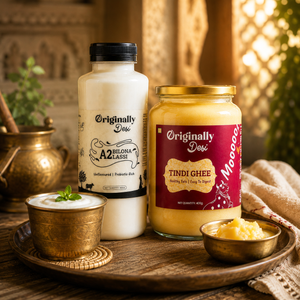
At dawn in Dhingsara, Haryana, yesterday's dahi goes into a wooden bilona. As it turns, two things come out of the same pot: the makhan that gathers at the top, and the chaas left behind.
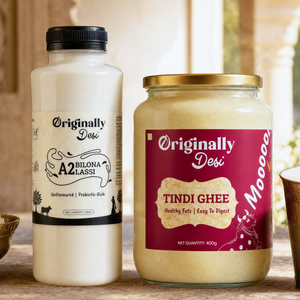
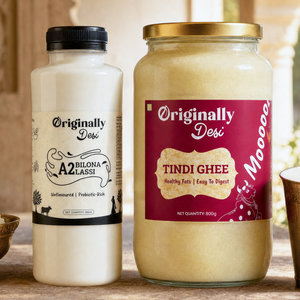
The makhan is A2 Tindi Ghee. The chaas is your A2 Bilona Lassi, packed the same morning. Nothing is left over, and nothing is added.
What you get
A2 Tindi Ghee 800 g + A2 Bilona Lassi 2x 500 ml
A2 Tindi Ghee 400 g + A2 Bilona Lassi 500 ml
What Tindi Ghee actually is It is not clarified ghee. Tindi Ghee, called nooni ghee in parts of Haryana, is the fresh cultured white butter that comes off the bilona before any heat touches it. Soft, pale and mild, where ghee is golden and grainy. Warm it slowly yourself and it will turn into ghee. Left as it is, it is the stage most people never get to taste.
Days, not months, and that is the point. There are no preservatives in either one, so nothing holds them longer than a few days. The makhan keeps about a week in the fridge. The lassi is quicker still, so drink it first, ideally within four days. Both need to go into your fridge as soon as they arrive.
Why we come only as far as Delhi NCR A fresh, unpreserved product cannot cross the country. We deliver across Delhi NCR so it reaches you with most of that freshness still in it. Our clarified A2 cow ghee keeps far longer and ships nationwide.
Tindi Ghee: A2 desi cow milk, in-house curd culture (jaman).
Fresh Lassi: A2 desi cow milk, in-house curd culture (jaman).
Two ingredients in each, and they are the same two. No sugar, no salt, no flavouring, no preservatives, no colour, no milk powder.
Tindi Ghee: Refrigerate as soon as it arrives. Best eaten within seven days of churning - the date is printed on the pack. It carries no preservatives, so do not leave it standing out. Always use a clean, dry spoon.
Fresh Lassi: Refrigerate immediately. Shake before drinking. Best consumed by the date marked on the bottle.
Cultured. Hand-churned. Made with traceability.
We make our makhan the traditional way, starting with overnight dahi made from A2 milk from free-grazing desi cows at our own farm. The dahi is then hand-churned on a wooden bilona, keeping the process simple and close to how makhan has traditionally been made. There is no added salt, preservatives or additives - just fresh cultured makhan with its naturally pale colour, soft texture and subtle unevenness.
| Feature | A2 Tindi Ghee | Typical packaged butter |
|---|---|---|
| What it is | Cultured butter churned from overnight dahi | Usually churned from cream, uncultured |
| Milk | A2 milk from free-grazing desi cows at our own farm | Pooled milk, herd and origin usually undisclosed |
| Method | Hand-churned on a wooden bilona | Industrial cream separator |
| Salt | None | Commonly salted |
| Preservatives & additives | None | Permitted additives are common |
| Shelf life | Seven days, refrigerated | Typically several months |
| Colour and texture | Pale, soft, uneven, because it was churned, not moulded | Firm, uniform, evenly coloured |
| Traceability | One farm, one village, named | Rarely stated |
No. Tindi Ghee, also called nooni ghee in parts of Haryana, is fresh cultured white butter, the makhan that comes off the bilona before any heat is applied. Ghee is what you get after that butter is slowly heated and clarified. Both come from the same churn, but they are different products with different textures, uses and shelf lives.
The makhan keeps about a week in the fridge. The lassi is best within about four days, so drink that first. Neither has preservatives, stabilisers or salt, and we would rather tell you that than add something to stretch them.
A fresh, unpreserved product cannot spend days in transit. Delivering across Delhi NCR means it reaches you with most of its life still ahead of it. Our clarified A2 cow ghee keeps far longer and ships anywhere in India.
Neither. It is plain, just the chaas from the churn, with nothing added. Most people finish it their own way with sugar or gur, or with salt and jeera.
Better not to. It still contains its milk solids, so it browns and burns at a much lower temperature than ghee. Use it on hot roti, or stir it in after the flame is off. For tadka and frying, use our clarified A2 cow ghee.
Yes, and it works beautifully. Warm it slowly in a heavy pan until the water steams off and the milk solids settle golden at the bottom. Strain, and you have your own ghee. That is exactly the next step in our own process.
The milk is first set into curd overnight, and the curd is then hand-churned in a wooden bilona to separate butter from buttermilk. The slower, older route. Most modern dairies skip the curd entirely and churn cream by machine, which is faster but gives you something different.
Yes. The milk comes from indigenous desi cows at our own farm in Dhingsara, Haryana, which naturally give A2 milk, not from crossbred herds. Our FSSAI licence number is printed on every pack.
Refrigerate both as soon as they arrive. Keep the makhan covered and always use a clean, dry spoon. Shake the lassi before drinking, and finish it within about four days. Neither should be left standing at room temperature.


