
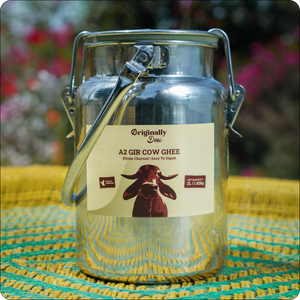
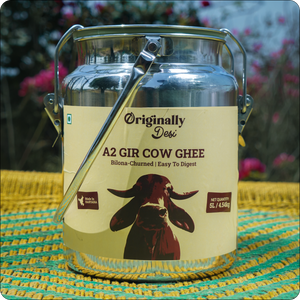
500 ml






Enter your PIN code to check estimated delivery time.
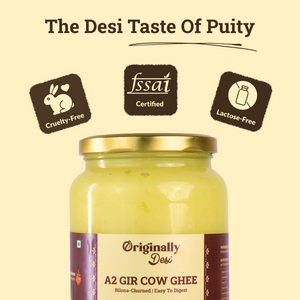
Grainy, fragrant, and thoughtfully made.
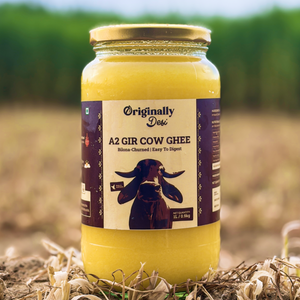
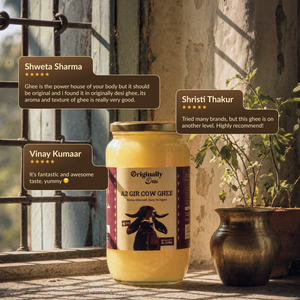
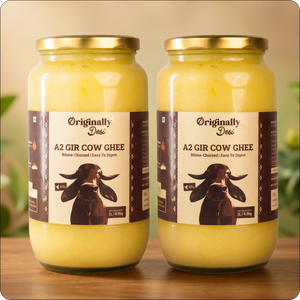
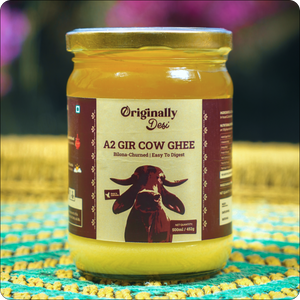
Our A2 Gir Cow Ghee brings a quiet richness to everyday meals. There’s a natural sweetness to it, a soft nuttiness, and a texture that melts slowly, not instantly. It doesn’t sit loudly on the dish, but you notice the difference from the first bite. From warm rotis to simple dal or a bowl of rice, it adds just enough to make food feel complete. Not heavy, not overpowering, just the kind of ghee you reach for without thinking twice
In the first week
Over the first jar
Unopened, it keeps for 12 months. Buying the bigger jar is not a risk.
From our farm to your jar
The calves eat first. Our Gir cows graze freely and are fed organic fodder. Every calf gets its share before a single litre comes to us.
If you have only ever bought supermarket ghee, a smooth uniform paste probably looks correct to you. It is not the tell you think it is.
Grainy, danedar texture happens when ghee cools slowly and naturally and the fat crystals get time to form. Rushed, machine-processed ghee is often cooled fast or stabilised, so it stays uniformly smooth. Ours will look different in December than it does in June, and it may separate into a softer top and a grainier bottom. That is butter fat behaving like butter fat. Warm it slightly if you want it pourable.
Supports smoother digestion by helping the body process food more comfortably, especially when added to warm meals.
Helps sustain energy levels through the day, making meals feel more filling and reducing the need for frequent snacking.
Contributes to better nutrient uptake, allowing the body to absorb essential vitamins more effectively from everyday food.
Supports mental clarity and focus as healthy fats play a role in overall cognitive function.
Adds to overall skin and hair health by supplying fats that support texture, softness, and strength over time.
Supports steady metabolism by providing a clean source of energy that the body can utilise efficiently.
Contributes to better gut comfort when paired with simple, warm foods like dal, rice, or khichdi.
Seasonal Use
Commonly included more during colder months when meals tend to be warmer and more comforting.
Keep it in a cool, dry place away from direct sunlight, with the lid closed. It does not need refrigeration, and it does not need to be finished quickly.
Always use a dry spoon. One drop of water is what spoils ghee, not time on the shelf.


No cream. No shortcuts. No confusion.
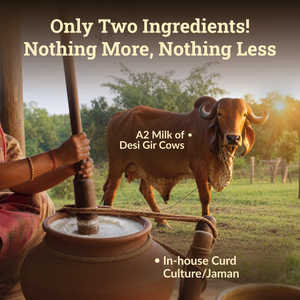
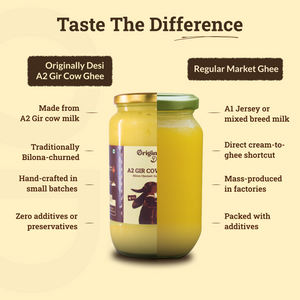
Most ghee on a shelf is made from cream, by machine, at speed. Ours is made from curd, by hand, at four in the morning. That one difference is why it takes 25 to 30 litres of milk to fill a single litre of our jar, and why it smells the way it does when you open it. We did not pick the slow method to tell a nicer story. We picked it because it is the one that works.
| Feature | Originally Desi A2 Gir Ghee | Typical supermarket ghee |
|---|---|---|
| MILK SOURCE | Free-grazing Gir cows on our own Haryana farm | Pooled milk, source usually not disclosed |
| METHOD | Curd set overnight, then bilona hand-churned | Cream separated by machine, industrial scale |
| PROTEIN TYPE | A2 beta-casein from an indigenous breed | Often A1, from crossbred cattle |
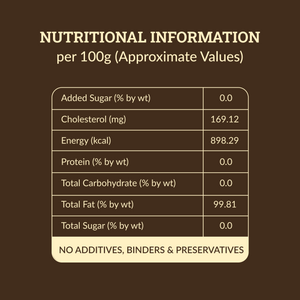
| INGREDIENTS | Milk and jaman. Nothing else | May carry added flavour or preservatives |
| TEXTURE | Grainy, danedar, changes with the season | Uniformly smooth year round |
| TESTING | Every batch tested and batch-coded | Rarely published |
| TRACEABILITY | We own the farm | Aggregated, hard to trace |
It is ghee made from the milk of Gir cows, an indigenous Indian breed from the Gir hills of Gujarat. Gir cows produce A2 beta-casein protein rather than the A1 protein common in crossbred and foreign cattle. Ours is made the bilona way: the milk is set into curd overnight, hand-churned into makkhan, and then slow-cooked into ghee.
Regular ghee is usually made by separating cream from milk by machine and heating it. Bilona ghee starts a step earlier: the whole milk is cultured into curd overnight, and the makkhan is churned out of that curd. It is slower, it needs far more milk per litre, and it produces a noticeably different smell and texture.
Because it cools slowly and naturally. Grainy, danedar texture is what happens when ghee is not rushed or stabilised. The texture will shift with the weather, and it may look different in summer than in winter. Warm it gently if you want it liquid.
Because it is made in small batches from milk that changes through the year with the season and with what the cows are grazing. Colour, grain and firmness all move a little. A jar that looks identical every single time is a sign of industrial processing, not of quality.
It takes roughly 25 to 30 litres of milk to make one litre of bilona ghee, against far less for cream-based ghee. Indigenous Gir cattle also yield less milk than crossbred cows, and the process adds overnight culturing and hours of hand-churning.
Ghee is clarified, which means most of the milk solids, where lactose and casein sit, are cooked off and strained out. Many people who avoid milk still use ghee comfortably. If you have a diagnosed dairy allergy, please check with your doctor first.
Most families use one to two teaspoons a day across their meals. It is a cooking fat, so treat it the way you would treat any fat in your kitchen.
Ghee is one of the first fats most Indian families introduce into a child's food, usually stirred into khichdi or mashed dal. Ours has two ingredients, milk and jaman, and nothing else, which is the main reason parents choose it. If you are introducing any new food to an infant, your paediatrician is the right person to ask about timing and quantity.
12 months from the date of manufacture, unopened. Store it in a cool, dry place out of direct sunlight with the lid closed. It does not need refrigeration and it does not need to be finished quickly. Always use a dry spoon, because one drop of water is what spoils ghee, not time on the shelf.
Both are bilona-churned from cultured curd. The A2 Gir Cow Ghee uses milk from Gir cows specifically, which is the rarer and more expensive breed, and it carries a slightly sweeter, more aromatic profile. Our A2 Desi Cow Ghee comes from our wider indigenous desi herd and is the everyday option. If you are new to us, start with whichever fits your kitchen budget.


